Monday, April 23, 2018

Science WAC Should we increase the usage of nuclear energy?

Should we increase the use of nuclear energy?

Have you ever turned on the news and seen things about a nuclear plant explosion? Or new government costs to sustain a nuclear plant? About places evacuated because of harmful nuclear waste? If you’ve seen it or not, whether the news reported it or not, this is happening. We may need a energy source that does not produce greenhouse gases, but nuclear is not the way to go. It is just to dangerous. With high costs, high risk of explosions and endangering the environment, it is not worth it. Nuclear energy has some good qualities but it is just not worth the bad.

Nuclear energy is very expensive. It can cost billions of dollars to build, upgrade, maintain and clean and store nuclear waste. Imn the article “Waste, Families left behind as nuclear plants close.” by Frank Morris it says, “Brock Lindau has spent almost his whole career at Fort Calhoun power plant. He helped install almost $700 million worth of upgrades to the plant.” This means that at just one nuclear power plant they spent almost $700 million just on upgrades. This shows that nuclear power plants are extremely expensive. Also in the video “Nuclear Energy: Is Fission the Future.” by Flipside Science, Scientist Dan Kammen says, “...And nuclear is very expensive.” This shows that it has been proven and is not a secret that nuclear is a very expensive energy. When you look on the whole of the situation, all of the nuclear power plants could cost well over a trillion dollars if you add all of the costs together. All that money to produce 20% of the Earth’s energy. It’s just not a good deal.

Even though it is very expensive and has many risks, people still believe that it may be a good source of energy. People say that it is a way that we can efficiently produce lots of energy without producing greenhouse gases. In the article “Waste, Families left behind as nuclear plants close.” by it says “A decade ago, low-carbon nuclear power had a bright future, as a tool to fight climate change.” But just how much would you be willing to risk just to be able to get a carbon free energy. People have died because of issues that have happened with nuclear energy power plants.

Nuclear energy also has a very high risk. Producing more nuclear waste then we know how to handle and the ability to cause massive explosions. It is just to easy to go wrong. In the article “Water, Soil and Radiation. Why Fukushima will take decades to clean up.” by Geoff Brumfiel it says, “Five years after an earthquake and tsunami caused a series of meltdowns at the Fukushima Dai-ichi nuclear plant in Japan… But there are still some problems.”  In that same article a man named Dale Klein, a former chairman of the U.S. Nuclear Regulatory Commision, speaks. He says, “ Perhaps the biggest problem is water,”  That same article also says, “It also says, “Groundwater from nearby mountains constantly seeps through the ruined building before spilling into the ocean...so far efforts to stop it have been only partially successful.” This means that sites like Fukushima that have exploded face a series of problems and some of them are really hard to fix. Another problem that Fukushima and pother exploded power plants are facing is soil. In the same article by Geoff Brumfiel a person named Azby Brown who is with the nonprofit organization Safecast says, “There are now about 9 million bags of decontamination waste from all over the prefecture that are being consolidated into these vast fields with these pyramids of radioactive waste,” This means that they have just piles upon piles of contaminated and decontaminated soil just sitting around and not being cleared. Explosions are really harmful to the environment and things around it. That’s not even including humans.

Nuclear power plant explosions can mean serious health issues and death for humans. In the article “What’s next for nuclear” by Gabriela Quiros it says “The worst one to date happened with a devastating explosion and fire at the Chernobyl plant in Ukraine in 1986, which released radiation across Europe.Twenty-eight rescue workers died from radiation exposure. Other health effects started to show up a few years later.” In that same article Dr. Lydia Zablotska, an epidemiologist at the University of California, San Francisco says “The primary finding so far is an increased risk of thyroid cancer and other thyroid diseases in those who were children and adolescents at the time of the accident,” This means that not only does nuclear explosions affect the environment it affects the health of humans.

Humans do need a efficient source of energy that is clean. We need a good alternative to fossil fuels. But unfortunately nuclear energy just does not seem as though it would be to great of a substitution. It may not produce greenhouse gases, but it does produce nuclear waste and when you look at the big picture, nuclear waste can be much more harmful. Also it costs millions, billions and maybe even trillions of dollars just for a small amount of nuclear power plants, imagine if that number doubled. Plus with fossil fuels it is very inexpensive. On the whole, with the risks, expenses and environmental issues, we need a different alternative. Until that is made possible we need to stick to fossil fuels.

Saturday, April 21, 2018

Nuclear Energy

http://freevector.co/vector-icons/shapes/science-symbol.html
Do you know what nuclear energy is? There are two types of nuclear energy. One is nuclear fusion, the other is nuclear fission. But let's back up a few steps. Nuclear energy is a clean energy source, meaning it does not produce carbon dioxide like fossil fuels. Nuclear energy is made in nuclear power plants across the globe and is used to produce about 20% of our energy. Now back to fission and fusion. These are the two different ways that nuclear energy is made. Let's start with fission. Fission creates energy by using a proton and a certain type of uranium. The proton hits the uranium molecule that splits the uranium molecule into two pieces and produces more protons. This all comes with a ton of energy. This heats water, which makes steam, which turn a turbine which then creates electricity. Then their is fusion. Hence the name his does include things fusing together. This is where two different molecules are fused together, this then creates a lot of energy that is used in the same process to create electricity. They both produce a lot of energy and a lot of Nuclear waste. Many people believe that the fact that it does not produce greenhouse gasses and is very efficient that it is a good idea. Others think that the risk of the nuclear waste is not worth the benefits. There can and have been bad accidents with nuclear power plants and nuclear waste. Almost all of them caused peoples death and damaging the environment. So where do you stand? Are you for or against it?

S&EP
SP3: Conducting Investigations

I answered the question of whether I was for or against nuclear energy when I investigated the subject of nuclear energy. I investigated what the ups and downs of using this energy. I also investigated how it works and why it is better than some other sources. This helped me to understand where I stood

XCC
Cross-Cutting Concept: Cause and Effect

In the process of nuclear fusion and fission there is cause and effect. To starts of with fission the proton crashes into the uranium which then causes it to break in half. Then that causes energy which causes the heating of water, this makes steam, steam then powers a turbine which then makes electricity. This is the same with nuclear fusion except for instead two molecules fuse together to create the energy.


Saturday, March 24, 2018

Plate Tectonics

All of the continentes sit on tectonic plates. Each year they move a tiny but. They move just as fast as fingernails grow. (Which by the way, is not fast). They mostly move in a range of 2-6 centimeters per year. Have you ever wondered why there are so many earthquakes here in California? This is because we sit on a fault line. Which is the outcome of a transform boundary, where two plates slide past each other. We have this faultline because parts of california sit on a plate boundary. This is the boundary between the Pacific Plate and the North American Plate.

S&EP
SP3:Conducting Investigations

I found out about the different plate boundaries and where they were when I investigated where each one was. I also was able to figure out how fast each plate moves. I also figured out what direction each of them were going. This is useful to predict things like earthquakes and volcanic eruptions.

XCC
Cross-Cutting Concepts: System and System Models

Tectonic plate movement is like a system. Caused by the convection currents in the mantle, the plates move and collide or diverge. If one thing in the system goes wrong, the whole things could stop. It the plates did not hit each other, they would eventually have to stop diverging. Then what would they do? If the convection currents stopped flowing the plates just wouldn't move. Tectonic plates is an intricately woven system.


Monday, March 12, 2018

Plate Tectonics Quiz Regrade


Convergent boundaries is the correct answer because these plate boundaries can form volcanoes which is the a path way for magma to push itself up onto the earth's surface. This now makes sense to me that I am looking back into my notes.


Convergent boundary is the correct answer because not all plates go towards each other. Take Divergent boundaries, they go away from each other. Therefore not all plate boundaries come together or go towards each other.


Transform boundary is the correct answer because transform boundaries slide past each other making fault lines. Also, when they slide past each other they create earthquakes. Therefore California would sit on a transform boundary.

Sunday, March 11, 2018

Tectonic Plates


                      Forming Mountains                                           Subduction zones

             
                Divergent Boundaries                                                  Materials Needed


                 Spreading Frosting                                                   Transform Boundaries

Have you every felt an earthquake before? Or seen a volcano erupt? Did you ever wonder why those things happen? Well the reason that these things happen is because of plate tectonics; The movement of the different pieces of crust caused by the convection currents of the mantle. Before we get into plate tectonic and earthquakes and volcanoes, lets look at it's history. Plate tectonics was discovered back in the 1900's by a scientist named Alfred Wegener. He first discovered that the plates moved when he looked at a map and realized that some of the continents looked like they could fit together. After a long time and lots of research Alfred Wegener was able to fit the continents together AND found lots of evidence to prove his point. Like fossils of dinosaurs that couldn't swim but were found on two sides of the ocean. Or rock formations of the same type from the same time period but on different continents. Though he had a lot of evidence, he still did not now how the continents moved. When he presented his idea's to the world of science he was laughed at and not taken seriously. It was only after Alfred Wegener died that scientists were able to discover tectonic plates. For, it was not the continents moving, it was the tectonic plates they sat on that was moving. But overall Alfred Wegener was right, Pangea, his super continent, was an actual thing.

Now that we have the background of plate tectonics, we can talk about what it is. Tectonic plates is the name that we give to the pieces of the earths crust. Now these plates move because of the convection currents in the earths mantle. You can't see them move, but you can feel it. This is where plate boundaries come in. Plate boundaries are the places where to plates meet. There are different types of boundaries that all give different results. There are divergent boundaries; where to plates push apart from each other and create mid-ocean ridges and valley rifts. There are transform boundaries; where to plates slide past each other and create fault lines and earthquakes. There are oceanic and continental crust collision boundaries; where oceanic and continental crusts collide and the oceanic crust goes under the continental crust and gets recycled back into the earth. This creates subduction zones and sometimes volcanoes further inland. Then there is continental crust collision boundaries; where to continental crusts push against each other to create mountains. So next time you see that there is going to be an earthquake in your area, you can thank Alfred Wegener for the heads up.

S&EP
SP2: Building models

I showed my work through a model when I did a lab on plate tectonics. I used frosting as the mantles and gram crackers and fruit roll ups as the crust. I then represented each type of boundary and what the affects where. After this I had a better understanding of how the plates moved and how that affects the earth.

XCC
Cross-Cutting Concept: Cause and effect

The whole process of plate tectonics is a big cause and effect story. You see, every type of boundary or way that a plate moves affects things. For example, at a transform boundary when the two plates slide past each other it then creates fault lines and earthquakes. The cause being that the plates are sliding past each other and the effect being the fault lines and earthquakes. This cause and effect is true for all kinds of plate boundaries. You just have to plug in the information, like the movement of the plate, and then what does that movement of the plate do to the earth, like form mountains or volcanoes.

Saturday, March 3, 2018

The rock cycle


         The rock cycle is what we use to describe the change in the form of rocks. Where we tend to start in the cycle is with a normal rock. A normal rock that over time is eroded and weathered into particles of rocks. From here these particles usually collect in water. This is where they are compacted and cemented in with other particles call sediment. Over time this creates sedimentary rock. Sedimentary rock is usually soft and breakable. You can see different pebbles and rocks. This is also the type of rock most likely to contain fossils. Some sedimentary rocks include limestone and conglomerate. Over the next few million years this rock is heated and compacted under the earth's surface to create metamorphic rock. Metamorphic rocks have ribbon-like layers and usually contain crystals form the soft minerals growing on the rock over time. Metamorphic rocks include marble and gneiss. Then after a lot of heat the metamorphic rock turns to magma. When this magma cools it creates igneous rock. Igneous rocks are usually shiny and have gas bubbles. But because this rock cools so fast there are no crystals. This cycle then repeats.

S&EP
SP3: Conducting Investigations

We simulated the rock cycle using starbursts to deeply investigate the rock cycle. First we cut us the starbursts and squished them together to create sedimentary rock. Then we used the heat from our hands and pressed the starburst to create metamorphic rock. Then we used a microwave to melt the starburst and then let it cool into "igneous rock."

Crosscutting concepts
XCC:Cause and Effect

There are many cause and effect situations in the rock cycle. Like, because of the cementing and compacting the sediment turns into a sedimentary rock. Or, because of the heat and pressure the rock them turns into a metamorphic rock. This happens for every type of rock. The reason why the rock changes is the cause. The rock that has just recently changed is the effect.

Wednesday, February 14, 2018

Save the grays monitor lizard

https://jpartsch0506.wixsite.com/grays-monitor-lizard


The gray's monitor lizard is less known in the world. It is even less known when you look at the list of endangered animals. Many people know of elephants, narwhals and tigers, but did you know of the gray's monitor lizard? The gray's monitor lizard is listed as threatened on the list of endangered animals. The Gray's Monitor Lizard is also known as the Varanus Olivaceus. The Gray's monitor lizard is an olive green color with gold and black spots which helps them survive in there ecosystem. Not to far in size to it's relative the Komodo Dragon, the gray's monitor can grow up to six feet long from the tip of its tail to the end of its nose. Though it can be huge it usually maxes out at 20 pounds. They usually live for 15 to 15 years.

Backward-Looking 

I actually knew somewhat a lot about the subject when coming into this project. This is because when I grow up I want to be a zoologist. When I found out that I was able to do that particular role in my project, I was really excited. Though I did not know a thing, not even the name really, of the animal that we choose to do. This means that I knew nothing about that particular thing. 

Inwards-looking

I think what is most pleasing about my project is that it is very creative. It is a good piece of work that I am happy with and that I like. I think what I like the most is the wix site that I created to manage our project and the data that we collected. I think that it looks nice and is very organized and well done.

Outwards-looking

I think that we did do our work differently them other groups. I think that what we included was probably the same. This is because we all included an infographic, food chain, timeline and research. But the way in which we organized it, through a wix site, was different from others.

Forwards-looking

If I could change one thing about this project it would be to take less time on research and more time on the product itself. I think this because the product making takes longer than research should. I do not think that we spent to much time on research, but it was probably more time than we should have.

Saturday, February 10, 2018

the Gray's Monitor lizard

Image result for gray's monitor lizard
https://commons.wikimedia.org/wiki/File:Monitor_Lizard_in_Thailand.JPG

I am sure that you know many endangered species, the elephant, narwhal and more. But do you know of the gray's monitor lizard. The gray's monitor lizard was believed to be extinct up until recently. It was rediscovered on a small island in the Philippines. Being part of the Varanus family, it is a relative to the huge Komodo Dragon. It is known to grow up to six feet from tail to nose, but only weighs up to 20 lbs. Its babies, after around 11 eggs, first laid in July through October, have a 300 day incubation time, are usually 8 inches and weigh 25 grams. Less than a tenth of a pound. They tend to be a Olive green-ish color with gold and black spots. As most of the members of the genus Varanus are, the gray's monitor lizard is an omnivore, though more than half of its diet is constructed of meat. It is a very shy animal and rarely has anything to do with humans. It simply lives in a tree, eats food, has babies and then eventually it dies. The problem is that for over 50 years we have been destroying their habitat. Not only that but it is rare that they are in zoos because it is so hard to have them reproduce in captivity, it has only been done about a dozen times in the western hemisphere. But they are also hard to raise. They have a strange diet and a strange way of eating their food.

S&EP
SP3: Planning and carrying out investigations

I planned and carried out investigations on the gray's monitor lizard. I did this by looking up facts about their lives and what they do. I have also investigated why they are going extinct. Even though that was not what I had to do, it was weird to me that they are going extinct when they have no interaction with humans because they are so shy.

XCC
XCC: Cause an effect

We humans are causing the gray's monitor lizard to go extinct. This is because over 50 years we have been destroying their natural habitat. There is also no way to have them thrive in captivity so that just makes matters worse. The fact that the are so hard to keep and have reproduce in captivity is part of the reason why. Over all we need to stop hurting the gray's monitor lizard's habitat because they have nowhere else to go except extinction. 

Saturday, February 3, 2018

Interactions between organisms.

https://upload.wikimedia.org/wikipedia/commons/1/1c/Smiling_Dog_Face.jpg
https://upload.wikimedia.org/wikipedia/commons/0/0d/Flickr_-_Rainbirder_-_Egyptian_Plover_(Pluvianus_aegyptius).jpg
https://upload.wikimedia.org/wikipedia/
commons/9/98/Alligator.jpg
https://upload.wikimedia.org/wikipedia/
commons/1/1c/Chilean_Mockingbird.jpg


There are many way in which animals within an ecosystem interact with each other. They have different relationships like predator prey relationships, competitor relationships and symbiosis relationships. The symbiosis relationship is made of three different relationships. The Parasitism relationship, Mutualism relationship and the commensalism relationship. A parasitism relationship is a win lose situation. Like the tick and the dog. The tick likes the dog because it gets blood but the dog loses blood and does not like it. A Mutualism relationship is a win win situation. Like the Egyptian Plover and the Alligator. The Egyptian Plover eats food and thing out of the alligator's mouth therefore getting food, and the alligator gets clean teeth. A commensalism relationship is a win-meh situation. Like the orchid and the tree. The orchid get light to grow and the tree could care less. A predator prey relationship is one between predator and prey, a win-lose situation. Like a shark and a fish the shark gets food and the fish gets eaten. A competitor relationship is one where two things are competing for something. This is also a win lose situation. Like the tree and the vine. The vine wraps around the tree to compete for sunlight the tree then doesn't get enough sunlight and dies. 


S&EP
SP2: Using Models.

I used models to show the different interactions between animals in an ecosystem. I did this by organising each different interactions. I then gave each box a tittle and a description on what it was about. This then turned into a diagram that I used to help me learn about the different interactions in an ecosystem.

XCC
XCC: Systems and System models


An ecosystem is a giant system found in different environments. There are changes and parts that all determine what happens in the ecosystem. All of the animal interactions are part of an ecosystem and are why they can work. Without animal interactions, there would be no such thing as an ecosystem because there would be no change and nothing would work together meaning it would no longer be a system.

Saturday, January 27, 2018

Biogeochemical cycles

Image result for water cycle

There are many cycles that take place on earth and in its atmosphere. Some of these are Biogeochemical cycles. This includes the water cycle, carbon cycle, phosphorous cycle, nitrogen cycle and sulfur cycle. This cycles are all vital when it comes to life. In other words we could not live without any of the cycles. But overall I think that the carbon cycle is the most important cycle. I think this because most, some could say all, things are made of carbon. In fact 18% of the mass of the human body is carbon.

Backwards-Looking

I think that if I was to improve something in my project it would be to make sure that my piece looks better and more professional. I also think that it could have told more of a story and have been neater. But overall I liked the work that it was pretty good. I just should have spent more time on the final piece and managed my time.

Inwards-Looking

The thing that was most frustrating to me during this project was that I can not draw nor did I manage my time so I was not rushed when I drew. I think that I could have managed my time better so my project would look neater. I think that it came out good, but it could have been better.

Outwards-Looking

I think that I would give this work an A. I think this because it was a good piece of work and it meet all of the criteria. Also it not only met the criteria but it showed that it did. I would not give it an A+ because I feel like it definitely be better.

Forwards-Looking

I think that the thing that I could improve upon for future projects is time management. I think this because I spent more time on my rough draft online, then I did on my final draft. I think that I could really use this skill in the future and that it will help me.

Saturday, January 20, 2018

The Water Cycle

https://c1.staticflickr.com/9/8485/8265072146_b216a812ae_b.jpg

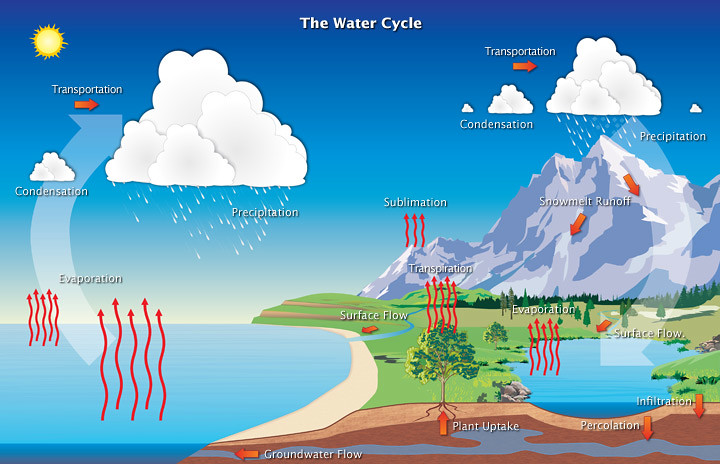
The water cycle is something that we all know about and that we all learned about. But there are somethings that people still do not know about. There is the well known cycle, evaporation, condensation, precipitation, runoff, infiltration and ground water flow. But what about transpiration, where plants release water into the atmosphere or when the sun evaporates water from the plants leaves and parts.  Then there is sublimation, where snow and ice turn into water vapor without going through the process of becoming a liquid. Then there is plant uptake, well when the plant takes the water in the ground and uses that for photosynthesis.


S&EP
SP2: Using Models

I have explained the water cycle and many of it's parts through designing cartoon images that show the process and steps. I have also done this through drawing these designs digitally to see what they look like. Not only that but I skectched plans to help me fully understand the water cycle.

XCC
XCC:Cause and Effect

The water cycle is one big pattern of cause and effect. For example, because the sun heats the water it causes the water to become water vapor, or evaporate. Or like how the water condensing causes the clouds to become heavy and precipitate. Also because the sun is hot, it melts the ice and snow caused by precipitation, to melt and create run off, which then is soaked up by the earth.

Is there life in Space?

News | The Solar System and Beyond  by JPL - NASA Have you ever watched sci-fi movies where there are aliens or extraterrestrial life, ...