Saturday, January 20, 2018

The Water Cycle

https://c1.staticflickr.com/9/8485/8265072146_b216a812ae_b.jpg

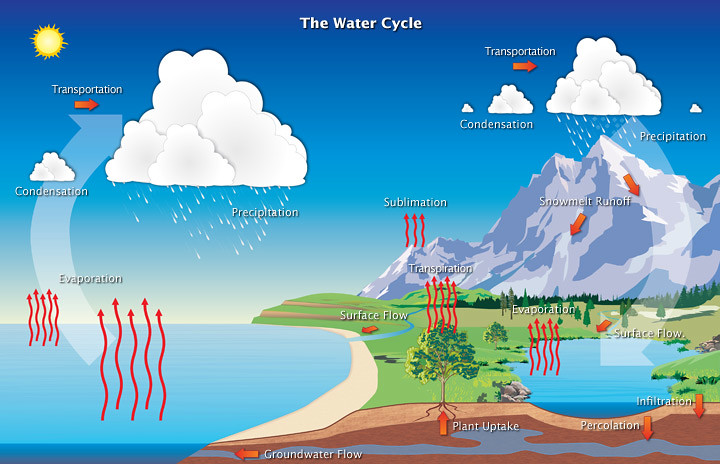
The water cycle is something that we all know about and that we all learned about. But there are somethings that people still do not know about. There is the well known cycle, evaporation, condensation, precipitation, runoff, infiltration and ground water flow. But what about transpiration, where plants release water into the atmosphere or when the sun evaporates water from the plants leaves and parts.  Then there is sublimation, where snow and ice turn into water vapor without going through the process of becoming a liquid. Then there is plant uptake, well when the plant takes the water in the ground and uses that for photosynthesis.


S&EP
SP2: Using Models

I have explained the water cycle and many of it's parts through designing cartoon images that show the process and steps. I have also done this through drawing these designs digitally to see what they look like. Not only that but I skectched plans to help me fully understand the water cycle.

XCC
XCC:Cause and Effect

The water cycle is one big pattern of cause and effect. For example, because the sun heats the water it causes the water to become water vapor, or evaporate. Or like how the water condensing causes the clouds to become heavy and precipitate. Also because the sun is hot, it melts the ice and snow caused by precipitation, to melt and create run off, which then is soaked up by the earth.

Sunday, January 14, 2018

Photosynthesis, Life in ecosystems and the Water Cycle. 1/8/18-1/12/18

https://commons.wikimedia.org/wiki/File:Екологично_равновесие3.jpg
                 What is photosynthesis? Life in ecosystems? The water cycle? and what do they have to do with each other? These are probably a few things that are racing through your brain right now.  We will start with the first question, what is photosynthesis? Photosynthesis is a process in which organisms use sunlight, water and carbon dioxide to make glucose, to store for energy, and oxygen. The exact opposite of this process is cellular respiration, where organisms use oxygen and glucose, or energy, to make carbon dioxide and water. But this is all just things that living or biotic things do. What about the non-living or Abiotic things? These things don't actually need energy, but they can help the things that do. It is a fact that Abiotic and Biotic things work together in an ecosystem. For example, a mouse might hide under a rock to escape a hawk.  But what does all this have to do with the water cycle? Well, there are a lot of cycles in life, the life cycle, carbon cycle, water cycle and more. These cycles are all parts of an ecosystem. If nothing was born and nothing died that would hurt an ecosystem. If nothing happens to water that could affect its use and ability to be used in an ecosystem.

S&EP
SP6: Constructing Explanations Designing Soulutions

I explained how Abiotic and Biotic things work together in an ecosystem. I also explained why photosynthesis is important for life on the planet. Not only that, but through my work I explained how Biotic and Abiotic things are important and needed in an environment.

XCC
XCC: Scale, proportions and quantity.

Scale proportions and quantities are important in a ecosystem. This is because without the proportions and quantities of different species in an ecosystem it could get out of control. If you unbalance things that can mess up the food chain and affect and potentially kill off all the animals that live in it.


Wednesday, December 13, 2017

Charity Fair 12/18/17-12/22/17


I of course know many things about myself, I love cheetahs, teal and my family. But when it comes to projects and school, I always have something to discover. I feel as though my recent work has shown a lot about my work ethic, growth and abilities. Though I have just recently discovered my love for presenting and being social, no matter how sick I feel while doing it. I discovered that when I actually care about something, I don't care what I am doing, i'm helping or acting on that cause. This charity fair I choose the Cheetah Conservation Fund, or CCF as my charity. I love this charity because it protects one of my favorite animals. This is something that I really care about. So when I got up and presented, the fear while waiting for my turn, melted away, I was fearless. That had never happened before.


Backward-Looking

I think that I have gotten better at this kind of work over the years because I have learned what to do and what not to do. I also think that my abilities to make something nice and good have improved. I feel like over the past few years I have been able to improve my work ethic and growth, so that each of my projects grow with me. I think that over all I have improved most when it comes to my presentation skills.

Inward-Looking

My standards for this piece were to get it done and get an A, sell more than half our product and to do it very efficiently. I think that not only did I meet my goals, but I exceeded my goals. I sold out of my products and I made it to finals for choosing a charity to represent our class, this was a great honor because I had never done it before. 

Outward-Looking

When people look at my work I want them to see all of the effort that I put into it. I want them to notice all the small details and finishing touches that we put in to make it better. I also want them to see that we worked very hard to make our product and that we took our time making our product.

Forward-Looking

One thing that I would try to improve upon the next charity fair is being more creative when I come up with a product. This is because I want to be unique and yet our product not be to out of this world and crazy. I also would like to make our slides a bit better.

Sunday, December 10, 2017

Is ecotourism helping or hurting our national parks 12/4/17-12/817 (weekly blog)

https://www.nps.gov/slbe/learn/education/classrooms/arrowhead.htm


Is ecotourism helping or hurting our national parks? This question has two sides to it and is also complicated. This is because there is lots of evidence backing up both sides of the question. Let's start with the first side of the question, Is ecotourism helping our national parks? Well, yes. In article two, Is Ecotourism Helping or Hurting Our National Parks?, it says, "Ecotourism is an industry that promotes responsible travel to natural areas. It can provide income and promote conservation–rather than exploitation–of natural resources. Sometimes, ecotourism is looked at as a solution to a lack of political will or general apathy toward conservation issues. The idea of ecotourism is to enhance the conservation of wild spaces and species in an ecosystem through the promotion of natural resources as a tourist attraction.”. In that same article it also says, "Ecotourism has many benefits. It boosts local economic growth, provides jobs and improves conservation awareness as it stimulates the desire to protect our parks. NPS activities provide more than 200,000 jobs and have $30 billion impact on the economy of the U.S. through visitor spending. Getting outside is also good for people’s physical and mental health, helping with everything from reducing stress to improving memory. Companies are recognizing these benefits for employees, and students’ performance can improve after spending time outside. In addition, our national parks provide a unique American experience, bringing people together to learn about our national heritage. Due to all of these benefits, many people support sustainable tourism.”


Even though ecotourism can be good, it also has a downside to it. In article 3, Keeping Bears Wild - Or Trying - At National Parks, a park ranger at Great Smoky's National Park, who works with protecting the wildlife, most of the time bears, named Williamson says "It's a very difficult window to try to capture, because neither one can behave themselves, humans can't help but get too close to bears or drop food crumbs on the ground; bears can't help but eat the crumbs.". He also says "He can educate all of the bears he wants here, but he can't educate all of the people." This is a problem that many of the parks face. Especially Great Smoky's National Park.


You see people just don't know how much they can effect the environment. Also in article 2, Is Ecotourism Helping or Hurting Our National Parks?, Sencer says "Visitors’ poor behavior has been a growing problem, too. especially in national parks. In the past couple of years, the national parks have made headlines several times because of human misbehavior. In 2015, a family interfered with a bison calf in Yellowstone National Park, which they had presumed was in danger because it was alone in the snow. Bison are physiologically equipped to handle the harsh winters in the midwest. In the end, the family’s misjudgment cost the bison its life after attempts to reunite it with its herd failed….Recently, a woman was sentenced for vandalizing sites in parks around the country, something that unfortunately has impacted many parks over the years.”


Not only that but on article 5, Is ecotourism and oxymoron?, Christie Wilcox says "Ecotourists around the world may be inadvertently causing more harm than good, and that certainly seems to be the case in Kona. No one knows how the mantas’ behavior has been altered by the nightly interactions with humans and the artificial plankton aggregations created by their lights...The Kona industry might be “taming” the rays, causing unforeseen harm — in addition to the damage to the reef and rays already documented.”. But no matter what ecotourism, in a way, is neither good, nor bad. It has it's ups and downs. So the answer to the question in paragraph one, is merely one's opinion. So what do you think?


S&EP

SP7: Arguing from evidence.


I used evidence for different articles to construct my opinion on if ecotourism is good or bad. I read 5 articles to help me with constructing my argument and opinion. Then I had to use quotes from the articles and relate them to one another. I then came up with the conclusion that ecotourism was bad for our national parks and the environment.


XCC

XCC: Cause and Effect


Humans cause a lot more harm to the environment then we know of. One of the ways we cause harm is in ecotourism. Ecotourism is good for us humans, but it make things a whole lot worse for animals and the environment. You see, the animals at the national parks get to used to seeing humans in their daily life. This make them tamer when they are around humans. This almost takes the 'wild' factor out of an animal. This then makes national parks more like a 'wild zoo'.

Friday, December 8, 2017

Is Ecotourism helping or hurting our national parks?-WAC


 Ecotourism is hurting our environment. Many people may think that ecotourism is help our environment, that by being an ecotourist, you are being one with nature. This unfortunately is not true. Of course you could still be one with nature, but it is not good for the environment. In article 3, Keeping Bears Wild - Or Trying - At National Parks, a park ranger at Great Smoky's National Park, who works with protecting the wildlife, most of the time bears, named Williamson says "It's a very difficult window to try to capture, because neither one can behave themselves, humans can't help but get too close to bears or drop food crumbs on the ground; bears can't help but eat the crumbs.". He also says "He can educate all of the bears he wants here, but he can't educate all of the people." This is a problem that many of the parks face. Especially Great Smoky's National Park.

Great Smoky's National park is probably the most visited national parks in the U.S. This is a huge accomplishment. But is it really? As Williamson said above "He can educate all of the bears he wants here, but he can't educate all of the people." When you have some 11 million people in your park they are hard to control and they can end up destroying the beauty and the 'wild' factory of national parks. This is seen a lot at Great Smoky's and other popular ecotourism sites around the world. Williamson see's the 'wild' factory almost fade away with bears. They call it habitation. In article 3, Keeping Bears Wild - Or Trying - At National Parks, Williamson says, watching the sow nose a rock aside. "This is how habituation happens. She's just tolerant of us right now. She doesn't even spook when a frustrated motorist honks his horn at the car in front of him. Her two cubs seem oblivious too, as they stumble over downed logs and try to keep pace with their slow-moving mother... They're learning right now," Williamson says. They're learning to not be afraid of humans, which puts them on that slippery slope to becoming problem bears."

Also it is not just happening to bears. In article 5, Is ecotourism and oxymoron?, Christie Wilcox says "Ecotourists around the world may be inadvertently causing more harm than good, and that certainly seems to be the case in Kona. No one knows how the mantas’ behavior has been altered by the nightly interactions with humans and the artificial plankton aggregations created by their lights...The Kona industry might be “taming” the rays, causing unforeseen harm — in addition to the damage to the reef and rays already documented.” In article 1, National Park Service Celebrates 100th Anniversary, Rott from npr says "So she's scaring it off because in order to preserve and protect this bear and these people, it can't be hanging out this close to a road and this close to people. It's good for pictures, but it's not good for the bear."

Not only that but people actually ruin other animals lives and the nature like coral, trees and other plants. In article 2, Is Ecotourism Helping or Hurting Our National Parks?, Sencer says "Visitors’ poor behavior has been a growing problem, too. especially in national parks. In the past couple of years, the national parks have made headlines several times because of human misbehavior. In 2015, a family interfered with a bison calf in Yellowstone National Park, which they had presumed was in danger because it was alone in the snow. Bison are physiologically equipped to handle the harsh winters in the midwest. In the end, the family’s misjudgment cost the bison its life after attempts to reunite it with its herd failed….Recently, a woman was sentenced for vandalizing sites in parks around the country, something that unfortunately has impacted many parks over the years.”

Also in article 5, Is ecotourism and oxymoron?, Christie Wilcox says "Lights in all directions from the dozens of dive groups disoriented us, and we were tossed this way and that by the high surge as our dive master attempted to move large, venomous urchins out of the way with tongs so we could sit on the reef. She instructed us to hold tight to the coral — even though touching the coral can kill it — as the water pushed us this way and that." She also says "I tried to remind myself that some of the money paid by all of these people would be used to conserve this place, to protect the majestic animals we anxiously awaited. But looking around, it was hard to believe that any of this was going to help the manta rays."

We may think that we are helping, but we are hurting the animals and their ecosystem. On the whole ecotourism helps us, through providing jobs, getting money, and letting us spend time in preserved nature. Yet it hurts the animals and their lives, by taking away the 'wild' factor within them and vandalizing their habitat. Ecotourism is bad and that is our fault. Here is this quote from article 3, Keeping Bears Wild - Or Trying - At National Parks, Williamson says "He can educate all of the bears he wants here, but he can't educate all of the people." and that is the problem.
Friday, December 1, 2017

Journey of Duct Tape key chains and wallets


      Did you ever wonder how much greenhouse gasses go into the air whenever you travel? Well I know, it turns out that when you fly in an airplane that it emits 0.8 grams of greenhouse gasses per mile. When you ride in your car it emits 0.41 grams of greenhouse gasses per mile. If you ever rode in a truck it emitted 0.17 grams of greenhouse gasses per mile. Finally if you ever rode in a rain it emitted 0.1 grams of greenhouse gasses per mile. Lots of our everyday product are made in China. For most of our products from China to California it goes by plane. From Guangdong, China to us is 5,530.4g of CO2/kg. That is a lot!

S&EP: SP4 Analyzing Data

We analyzed data when we had to find all of the mileage and CO2 emitted into the atmosphere from all of our products transportation. We also had to analyze all of the data that we got from the CO2 emissions and turn it into a description. We also had to analyze ourselves when we thought about how we impact the world with our CO2 emissions.

XXC: Structure and Function

The function of our map depended on the structure of our map. This is because when we made the map we had to do everything in a certain way so that it was interactive and so that everybody knew that one thing came from one place to another. A;so it depended on the structure so that we could get the correct mileage.


Friday, November 17, 2017

Clean it up 11/13/17-11/17/17


     Have you ever spilled something? I bet you have. But have you ever spilled hairspray on a plant? That's probably not one of the things that you would see daily. Then to clean it up did you use vinegar? I highly doubt that. But guess what, I did exactly that. My group and I had to try to neutralize a chemical. For our chemical we chose hairspray. Hairspray is surprisingly a base. We decided, off of our knowledge of neutralizing acids and bases, that we were going to use the acid, vinegar, to try to neutralize our base, hairspray. Once we ran our tests and experiments we found out that the hairspray had little to no effect on our plant and that our plant lived on. We used 100 mL of water on each plant, to keep them alive, 10 mL of hairspray on each plant, to simulate the spill, and 1 mL of vinegar, to neutralize the hairspray. We only used 1 mL of the vinegar because it is a strong acid and we didn't want that to kill the plant.

Backwards-looking

I think that a few problems that I had during this project was time management. This is because I was focusing on one thing more than another. This resulted in me having to start a document that was due the next day and work on that because throughout the whole week I was to focused on another part of the project.

Inwards-looking

I think that my goals for this piece of work is to have it be really realistic and that it was logical. I think that my goals changed along the way because I realized that it was hard to make a good news cast the was very realistic and that made sense. But I feel as though I did reach my goal of it being logical.

Outwards-looking

I think that if someone else were to look at my piece and learn something about me the one thing that they would learn about me is that I can improvise. I think this because on the night before something was due I was able to do half of it and prepare myself for the last class period that I would have to work on it so that I could manage my time well.

Forwards-looking

One thing that I think that I want to improve upon is my time management. As I said above that is not one of my strong suits. Also I feel as though that is something that a person needs to be successful. I also think that it is a valuable skill.


Wednesday, November 15, 2017

Chemistry Mastery Quest 2 Regrade 11/15/17

Question 3:

The question was "In a chemical reaction, the number of reactant atoms?". I answered "does not determine the number of the product atoms". The correct answer was "is equal to the number of product atoms". I see how this was the right answer because in the law of conservation matter it says that matter can not appear nor disappear or change it's identity.

Question 6:

The question was "Reactions that involve burning are classified as?". I answered " Endothermic". The correct answer was "Exothermic". I see how this is the correct answer because exothermic reactions give out heat which is something that happens when things burn.

Question 13:

The question was "Copper (Cu) reacts with oxygen (O) to form copper oxide (CuO). The properties of CuO are most likely?". I answered " Similar to both Copper and Oxygen". The correct answer was " different from copper or oxygen". I see how this is the correct answer because when a chemical reaction occurs the two reactants turn into different products so they would have different properties. 

Friday, November 10, 2017

Herbal Essences Body Envy Volumizing Hairspray Chemical Spill 11/6/17-11/10/17

Upload.Wikipedia.com (From google explore photo's)

Did you know that there are some mildly dangerous chemicals in hairsprays. Herbal Essences Body Envy Volumizing Hairspray has a hazardous ingredient, Cyclopentasiloxane, which is a fatty acid, ‎this chemical can cause cancer. It is fairly flammable and used for antiperspirants, skin care products and hair care products. The first aid procedures that you need to take are: If you swallow it, wash your mouth thoroughly with water, then get medical attention. In case you inhale the substance get outside  \to fresh air. In case it comes in contact with your eyes rinse them immediately with lots of water for 15 minutes, then you should seek medical attention. In case it touches our skin wash with lots of water, if irritation starts, it is recommended that you seek medical attention. You should also remove contaminated clothing. Warning: If you consume more than 800 ml of this chemical you could die. Cyclopentasiloxane has many chemical properties, it has a formal charge of 0. It’s heavy atom count is 20, it’s defined atom stereo center count is 0. It’s undefined atom stereo center count is 0. It also has a bond stereo center count of 0 and a undefined bond stereo center stereo center count of 0. It has a isotope atom count of 0 and a covalently-bonded unit count of 1. It’s hydrogen bond donor count is 0, it’s hydrogen bond acceptor count is 5 and it’s rotatable bond count is 0. Finally it’s compound is canonicalized. It also has a lot of Physical Properties. It’s Molecular weight is 370.77 g/mol, it’s complexity is 285, it’s exact mass is 370.094 g/mol, it’s monoisotopic mass is 370.094 g/mol, it’s topological polar surface area is 46.2 A^2.

S&EP
SP3: Constructing investigations.

I constructed investigations when I researched what was the dangerous chemical in our substance that we needed to clean up. I also had to construct investigations when i had to figure ways that we might want to neutralize our chemical and how we would do that. I also had to construct an investigation when I choose what brand we wanted to use for our hairspray.

XXC
XXC: Matter and Energy

Matter is a part of our investigations because we had to figure out how our product was structured physically and chemically. Matter is also a part of our chemical or related to our chemical because our chemical has matter. Energy is a part of our investigations because we had to figure out how reactive our dangerous chemical, or the chemical that we wanted to clean up, which is also dependent on how much energy is in the chemical or substance. Energy and matter were included in our investigations because they are both parts of our chemical and what it is made out of.


Sunday, November 5, 2017

Acids, Bases and the pH scale 10/30/17-11/3/17


What are the properties of an acid? Well, acids are very corrosive to metals, they taste sour, feel sticky, have a positive ion and they turn litmus paper red. Litmus paper is a piece of paper that when put in a substance turns a certain color depending on its acidity. A base is a substance that is not very acidic. Some of its properties are that it tastes bitter, is slippery or slimy, they are also corrosive to metals, turn litmus paper blue and they have a negative ion. But what's in the middle? If the substance is not an acid or a base then it is a neutral. A neutral is like water and they don't do anything to litmus paper. There are also ways to neutralize acids and bases. Sense they are opposites all you have to do is add them together. For when you add a acid to a base or a base to an acid you will always get at least water and salt which are both neural substances. One way that you can find out if something is neutralized or not is if you use indicator. You add indicator, that will change its color to match the universal indicator pH color chart or scale, and either the acid or the base. Then you have to add an acid to the base or a base to the acid until the substance turns the color green or the universal indicator color for neutral. But what is the pH scale? The pH scale is a color scale that tells you the amount or acidity that is in a substance.


S&EP
SP3: Planning and carrying out investigations

We did experiments with the pH scale and neutralizing acids and bases. We used everyday household substances like detergent, water and vinegar. We added those to indicator to test our knowledge of the pH scale and how it works and used that to find out how acidic or basic it was. We then neutralized vinegar and baking soda solution.

XCC
XCC: Energy and matter

Energy and matter are involved in acids, bases and the pH scale because energy is a part of the different ions that are properties of both acids and bases. Matter is involved because they are both types of matter.

Saturday, October 28, 2017

Using reactions to figure things out 10/23/17-10/27/17

Related image
https://kcls.bibliocommons.com/events/57f3f225a07b3901005914b6

Do you know how to classify a reaction? Classifying reactions is when you figure out if the reaction is a Single or double displacement, synthesis, or Decomposition reactions. A single displacement reaction is where one molecule will trade one part or piece of its particle with a different type of atom leaving the traded atom on its own. A double displacement is where two different molecule will trade one part of its molecule with the others, leaving the two 'rejects' together. A synthesis reaction is when two or more atoms come together to create one thing. A decomposition reaction is when a molecule breaks into its separate pieces leaving each part on its own.Not only that but there are two different ways that energy is involved in reactions. Endothermic and Exothermic are the two different ways that energy can be involved in a reaction. An endothermic reaction is a reaction where the products have more energy then the reactant therefor absorbing the energy in the surrounding materials. An exothermic reaction is a reaction where the reactants have more energy then the products therefore the reaction let out heat or energy into its surroundings.  Endothermic reactions are warm because of the energy transfer where as exothermic reaction are cold because of the energy transfer. Reactions are often used to find unknown items. This is done by making chemical reactions between known things and the unknown thing using the same reactants and seeing how each one is different and similar throughout the reaction to identify the unknown substance.


S&EP
SP4: Analyzing data

We analyzed data when we used chemical reactions to figure out a unknown substance. We had to analyze what happened when we added one substance to another. We had to analyze what happened and make a conclusion on what that unknown substance was. When we had fully analyzed the data we found out that the unknown substance was baking powder.

XCC
XCC: Energy and Matter

Energy and matter take part in reactions because of the energy transfer and the fact that they are a catalyst which means that they are used to start reactions. Energy is transferred through chemical reactions in two different ways. endothermic and exothermic reactions. A catalyst is a substance like water or energy or heat that is used to speed up or slow down the rate of a chemical reaction. Matter takes place in chemical reactions through the fact that all of the parts of a chemical reaction is matter.

Is there life in Space?

News | The Solar System and Beyond  by JPL - NASA Have you ever watched sci-fi movies where there are aliens or extraterrestrial life, ...